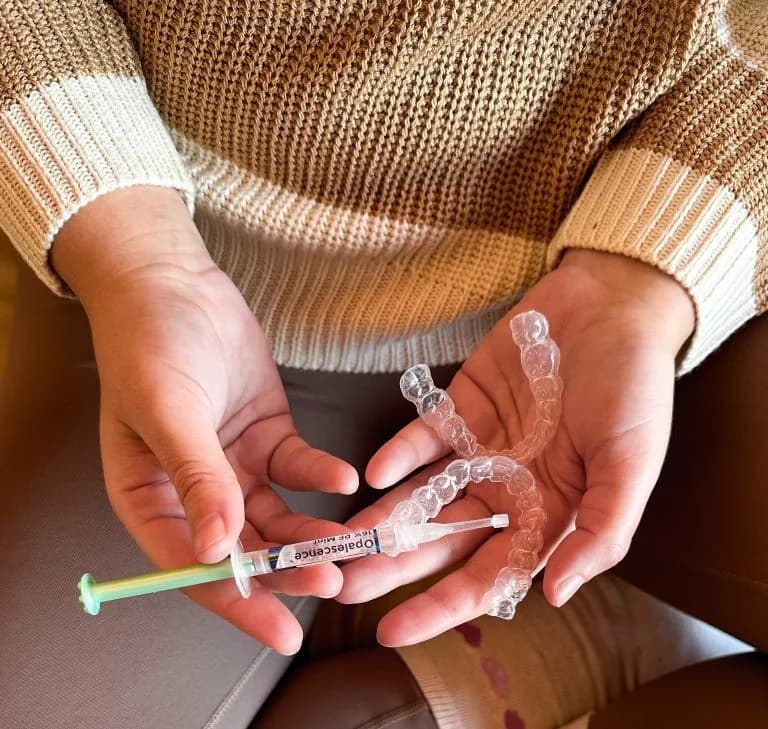
Whitening means lightening your own teeth with a gel that penetrates the tooth tissue and breaks down discolouration. It can be done at the practice or at home, using custom-made whitening trays. Whitening works on natural tooth tissue: fillings, crowns, bridges and veneers do not change colour with it.
Discolouration can come from the outside — coffee, tea, red wine, smoking — or from within, for example after root canal treatment or because the tooth tissue changes over the years. Not every type of discolouration responds to whitening. The teeth and gums are examined beforehand: whitening is not carried out in a mouth with untreated decay or inflamed gums.
First there is an examination and, if needed, a cleaning. For whitening at home, custom-made trays are made, which you use with the gel provided, following the instructions you receive. For whitening at the practice, the gums are protected and the gel is applied by the dentist. The dentist will discuss which approach suits you.
During and after whitening, teeth can be more sensitive to cold and heat. The result is not permanent: teeth discolour again over the years, and more quickly with coffee, tea and smoking. The dentist will discuss whether and when topping up the whitening is useful.
This page gives general information about the treatment. It is not advice about your own situation: what applies to you will be decided by the dentist after an examination. If you have a question or a complaint, please call the practice on (0032) 089 44 02 01.
Stalenstraat 133, 3600 Genk
The map has not been loaded, because this would send your data to Google.
Leave a message or call the practice. We will get back to you as soon as possible.